Waymore Tools
Today's Insights: A Potential Supply Chain Crisis that Affects the World is Gradually Approaching
Table of Contents
Strike Storm
The International Longshoremen's Association (ILA), the largest maritime workers' union in the United States, has threatened the United Shipping Alliance (USMX) that if a new wage agreement cannot be reached before the contract expires on September 30, tens of thousands of its members will go on strike at all its Atlantic and Gulf Coast ports on October 1.
The key issue in the dispute is a wage increase. The union is demanding a nearly 80% wage increase over six years, arguing that workers deserve a share of the profits foreign container shipping companies made during the pandemic. On the other hand, USMX is showing reluctance due to funding constraints and concerns about setting a costly precedent.
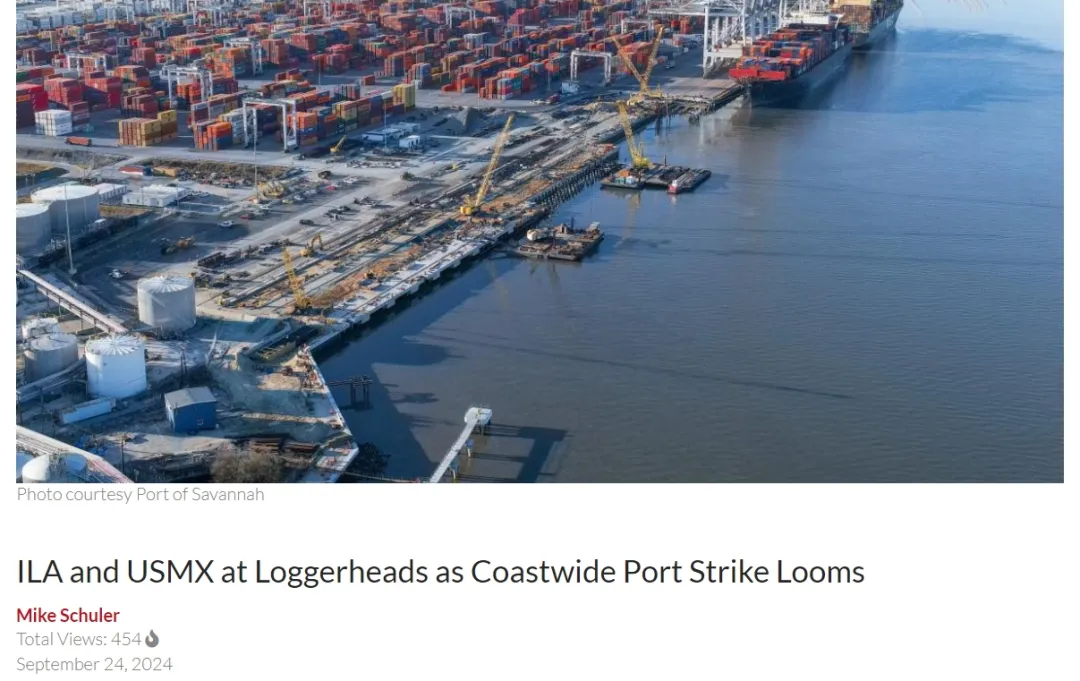
On September 23, both parties issued public statements accusing the other of refusing to negotiate. Judging by these latest declarations, the negotiation gap remains wide, and the risk of a major strike continues to grow. As the deadline approaches, the likelihood of strikes affecting port operations along the East and Gulf Coasts seems more and more inevitable.
How Big is the Impact?
Oxford Economics, in its latest report, noted that the strike could involve as many as 45,000 port workers. If the strike occurs, it would impact dozens of ports from Maine to Texas, disrupting approximately 60% of U.S. shipping volume, which could severely affect freight across the country.
East Coast ports handle 43% of U.S. imports, so any shutdown could cause significant supply chain delays. Industries such as retail, food supply, and automotive, which rely on just-in-time inventory management, are expected to be particularly affected, potentially resulting in empty shelves and rising prices.
Analysts warn that the strike could affect millions of goods, including bananas, plywood, and auto parts, as well as the broader supply chain system. Global companies may need to reassess their strategies to deal with potential port closures and transportation delays.
Jason Miller, a supply chain management professor at Michigan State University, emphasized that exports like plastic resin and imports like auto parts would be heavily impacted. Experts suggest that a week-long strike could result in losses of up to $7.5 billion to the U.S. economy.
Shipping Giants Have Imposed New Surcharges
Shipping companies like Germany's Hapag-Lloyd and Norwegian automotive transport giant Wallenius Wilhelmsen have developed contingency plans to minimize disruptions. However, Mike De Angelis, head of international solutions at FourKites, cautioned that even with such plans, a strike could "strangle the main artery of global trade." He warned that even after the strike ends, the backlog of goods could cause delays for weeks or even months.
Several shipping companies have already imposed surcharges to anticipate the strike. On September 1, MSC notified customers that from October 1, an emergency operating surcharge (EOS) of $1,000 per 20-foot container and $1,500 per 40-foot container would be added to all cargo bound for the East Coast of the U.S., the Gulf Coast, the Caribbean, Mexico, and Canadian ports.
CMA CGM followed by announcing that from October 11, a destination port surcharge of $1,500 per TEU would be applied to all imported cargoes in the U.S. East and Gulf Coasts. For export cargo, surcharges of $800 per 20 feet and $1,000 per 40 feet will apply. Additionally, a freight recovery fee of $500 per TEU will be imposed on all transatlantic freight starting October 1.
On September 18, Hapag-Lloyd added a disruption surcharge of $1,000 per TEU for containers shipped to the U.S. East and Gulf Coasts, further underscoring the industry’s serious concerns about a potential strike.
South Korean shipping giant HMM also adjusted its fees, announcing that from October 19, a destination port surcharge (DPC) of $1,500 per TEU and $3,000 per FEU will apply to all goods imported to the U.S. East and Gulf Coasts.
All stakeholders are encouraged to monitor developments closely and take precautionary measures to mitigate potential disruptions.